The FIFA World Cup, one of the world’s biggest sporting events, has brought together 48 national teams and millions of fans in stadiums and online. The surge in online activity has created unprecedented Internet traffic, turning the tournament into a real-world stress test for Internet resilience.
This has inspired the global Internet Society to put national Internet ecosystems “on the field” by organizing the World Cup of Internet Resilience. Using a 100-point scale, the resilience of the Internet in 179 countries has been evaluated across four key areas: infrastructure, market readiness, performance, and security.
Through its “The World Cup of Internet Resilience” analysis, the Internet Society has been publishing country rankings throughout the tournament, demonstrating that even technologically advanced nations are not immune to weaknesses in Internet resilience.
For example, England scores 72 out of 100. Around 80% of the country’s most-visited websites are served from local servers or caches, reducing dependence on international connections and improving performance. However, only 13% of DNS queries are protected with DNSSEC.
Brazil ranks first globally in competition within the Internet Service Provider (ISP) market. Its weaker area is routing security: seven routing security incidents were recorded in May 2026 alone. Overall, Brazil achieves an Internet resilience score of 67 out of 100.
Argentina receives a resilience score of 59/100. One of its strengths is network interconnection: 82% of active networks are members of Internet Exchange Points (IXPs) or customers of IXP participants. On the other hand, less than 1% of .ar domain names are protected by DNSSEC.
In the current Internet Resilience matchup between Spain and Argentina, Spain is leading with a score of 70% to 59%, out of a possible 100%.
You can explore the scores of other countries here.
The main conclusion of this “Digital World Cup” is clear: Internet resilience cannot be measured by a single indicator. Fast connectivity does not necessarily mean a secure Internet, high availability does not guarantee strong local infrastructure, and an advanced network does not automatically imply widespread adoption of modern technologies.
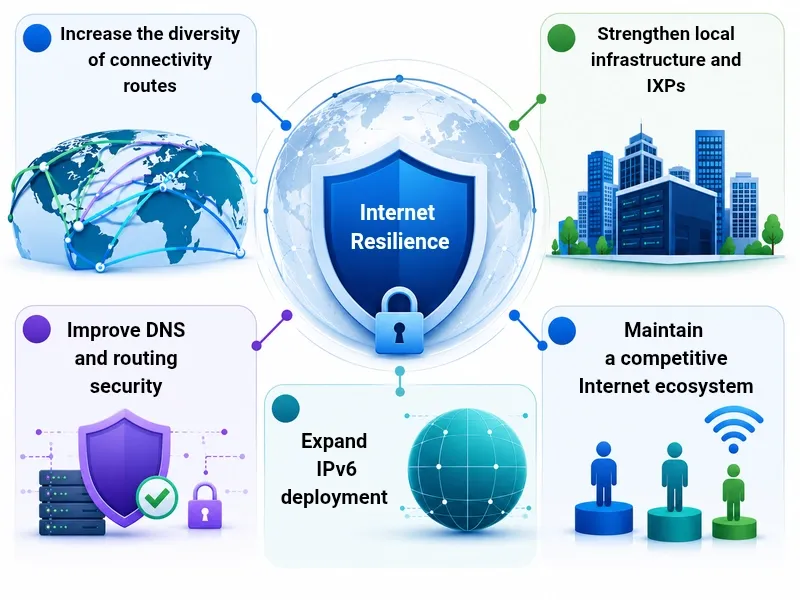
Countries should therefore prioritize not only expanding Internet access, but also strengthening local traffic exchange through IXPs, increasing the deployment of DNSSEC and IPv6, and investing in local data infrastructure. According to the Internet Society, it is the combination of these factors that creates a more resilient Internet capable of withstanding disruptions.