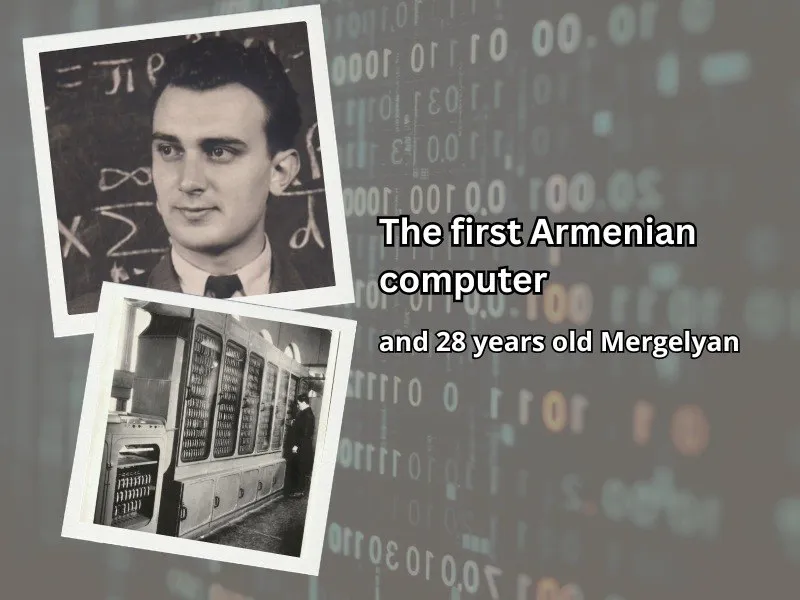
In 1959, Armenia made a historic leap into the emerging world of computing. By consolidating the country’s scientific potential, the Yerevan Scientific Research Institute of Mathematical Machines developed Armenia’s first computer-“Aragats.” Designed to perform complex scientific and engineering calculations, it marked the beginning of a new technological era for the republic.
Two years later in 1961, the institute widely known as Mergelyan’s Institute – introduced the “Horizon” computer. With improved performance and expanded capabilities, it was already being applied to industrial projects, reflecting the rapid pace of advancement.
At a time when computer technology was only beginning to take shape globally, Armenia despite its small geographic size was making a substantial contribution. Step by step it established itself as one of the Soviet Union’s leading technological centers, pushing the boundaries of science both within the USSR and beyond. This achievement was no coincidence; it was the result of a clear scientific strategy, strong state support and the exceptional talent of Armenian scientists.
The institute founded by 28-year-old Sergey Mergelyan, quickly became one of the USSR’s pioneering research centers in computing technologies, playing a decisive role in shaping the field.
Armenia’s true technological breakthrough came with the development of the “Nairi” computers in the 1960s. Remarkable for their time, these machines combined high processing speed with flexible programming and were widely used in industry, science, and military applications. Many experts consider them conceptual forerunners of modern personal computers.
Armenia also emerged as a leader in multiprocessor computing. The “Sevan” system was capable of executing multiple computational processes simultaneously an innovation particularly vital for military and strategic programs requiring rapid and reliable data processing.
In the 1970s, Armenia contributed to one of the Soviet Union’s largest technological initiatives: the development of Soviet equivalents of the American IBM System/360 computers. Armenian scientists were responsible for creating key components of the ES (Unified System) computers, which were deployed in public administration, banking systems and military infrastructure.
The country’s technological expertise also found application in the civilian sphere. Express-2 became one of the largest automated control systems in the world, managing railway ticket sales and serving millions of users across the Soviet Union.
A significant share of the computers produced in the USSR were developed in Armenia. The Yerevan Scientific Research Institute of Mathematical Machines, along with the research centers established on its foundation, became crucial pillars of Soviet technological progress.
Beyond building machines, Armenia’s early computer pioneers established a lasting scientific school. As noted in an article by Samvel Shoukuryan, the influence of that school continues to shape modern Armenia, helping the country’s IT sector remain aligned with global technological advancements.