Expanding mobile network coverage across Armenia is an important step toward digital development, but it is not enough on its own. A truly inclusive digital environment requires all residents, including those in rural and remote communities, to have access to fast, reliable and affordable internet. Equally important is the development of secure, interconnected and resilient infrastructure capable of supporting essential digital services. These priorities were at the center of the thematic session, “Towards a Unified Digital Armenia: Regional Connectivity, Digital Public Infrastructure and Equal Access,” held as part of ArmIGF2026.
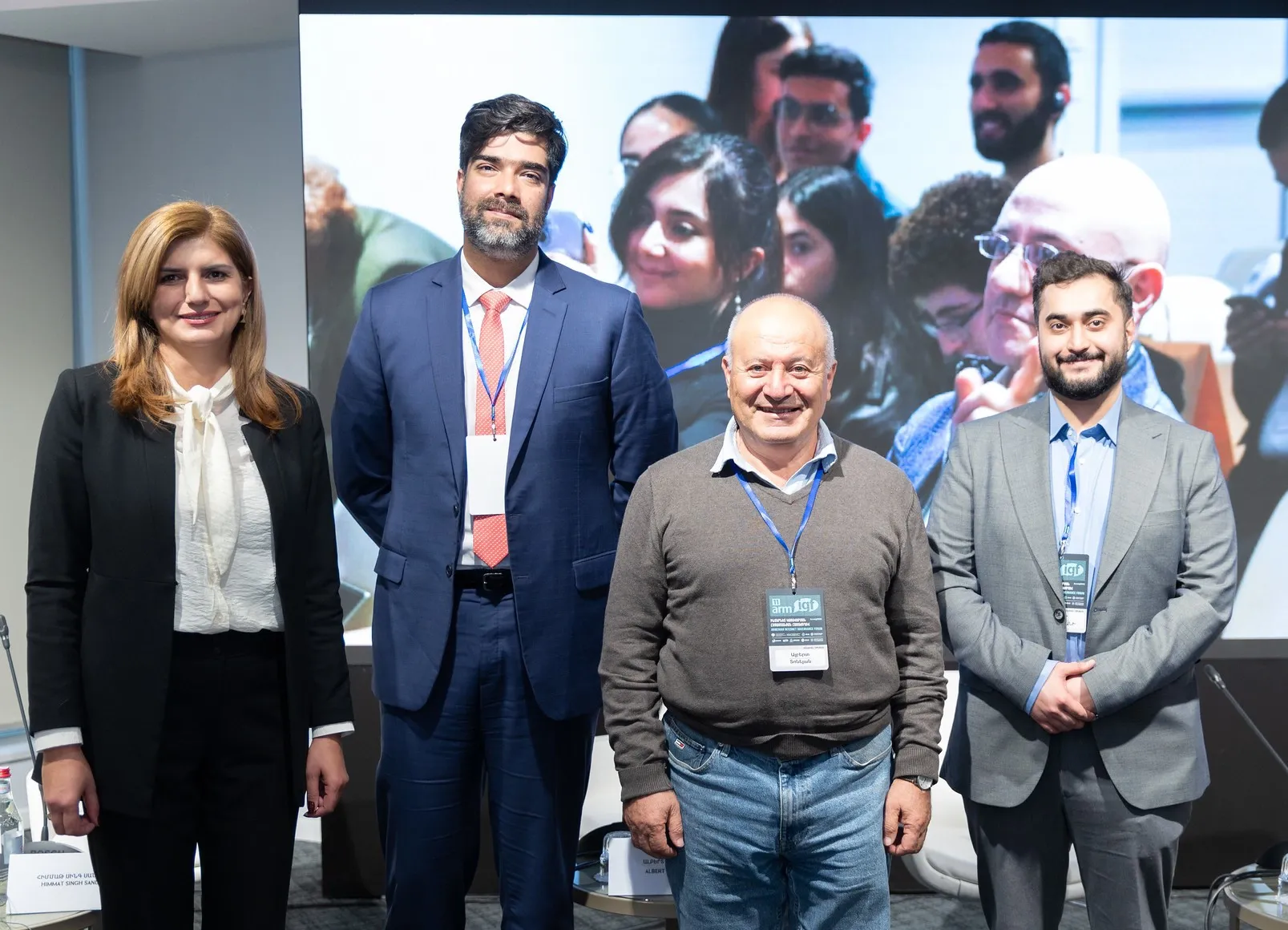
The session was moderated by Kristine Gyonjyan, Director of the Armenian Union of Operators NGO. The speakers included Himmat Singh Sandhu, Digitalization Specialist at the World Bank; Albert Toneynan, Board Vice Chair of the Internet Society NGO and President of ARMIX; Amir Soleimani, Head of Cloud Systems and Infrastructure Networks at EdgeSimplify; and Shant Kasardjyan of the Information Systems Agency of Armenia.
Presenting the preliminary findings of a study on broadband connectivity in Armenia, the World Bank representative noted that nearly 100% of the country’s territory is covered by some form of mobile internet service. However, geographical coverage does not necessarily translate into access to high-speed, reliable connectivity. Currently, approximately 70-80% of households have access to fixed broadband internet. While fiber-optic technology is used in many cases for the final connection to households, more than 200 rural settlements still lack fiber-optic infrastructure along the broader middle sections of the network.
This connectivity gap affects approximately 20,000 households, representing an estimated 70,000-80,000 people. The study also identified around 30 remote villages where deploying fiber-optic networks may not be economically viable. In such locations, satellite connectivity and other alternative technologies could offer practical solutions.
At the same time, preliminary assessments indicate that extending next-generation fiber-optic networks to at least 190 villages is economically and technically feasible. The required investment is estimated at USD 20-25 million. Given the relatively low population density in these areas, approximately half of the investment may need to be supported through public funding. For telecommunications operators, the expected investment recovery period could range from five to ten years.