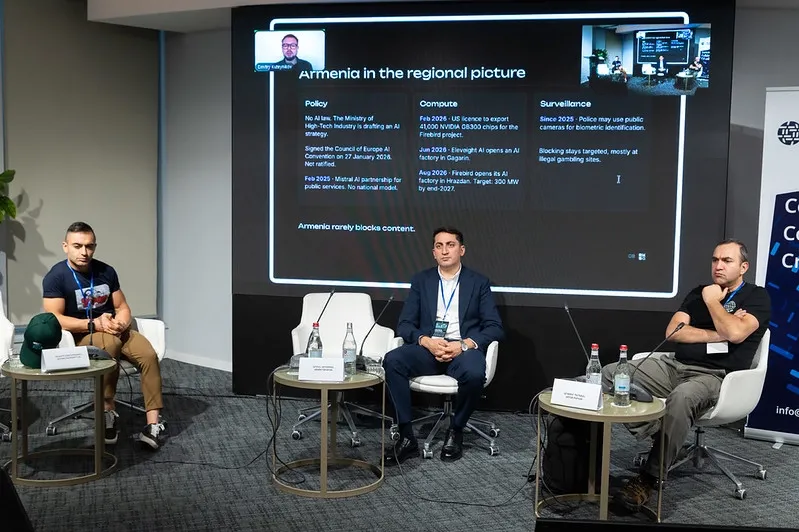
Almost 100% of Armenia’s territory is now covered by mobile internet. However, this does not mean that all residents have access to fast and reliable connectivity. Meanwhile, the expansion of digital services, remote work, online education, and AI applications requires next-generation broadband networks. This was highlighted by Himmat Singh Sandhu, a World Bank Digital Development Specialist, at ArmIGF2026, held in Yerevan on November 6.
His presentation was based on a study of Armenia’s broadband infrastructure. According to Sandhu, it is important to distinguish between internet availability and the quality of connectivity. For example, a single computer needs a connection speed of at least 25 Mbps for an online video call, while simultaneous online classes across an entire school require gigabit connectivity. Therefore, infrastructure must not only meet current demands but also be scalable and upgradeable without requiring the entire network to be rebuilt.
According to the study, approximately 68% of households in Armenia have fixed broadband internet access. Most fixed connections are fibre-optic, but the number of subscribers using high-speed packages remains relatively low. World Bank data show that only 21% of fixed broadband connections offer speeds of 100 Mbps or more, compared to the European Union average of 72%. This gap indicates that the challenge is not simply the availability of networks, but also ensuring that people can access higher-speed connections.
The study also analysed approximately six million speed test results recorded on the Ookla platform over a four-year period. More than 20% of these tests recorded speeds of 100 Mbps or higher. According to Sandhu, there are still settlements in Armenia where fibre-optic infrastructure reaches the final connection point, but the necessary infrastructure linking it to the backbone network is missing.