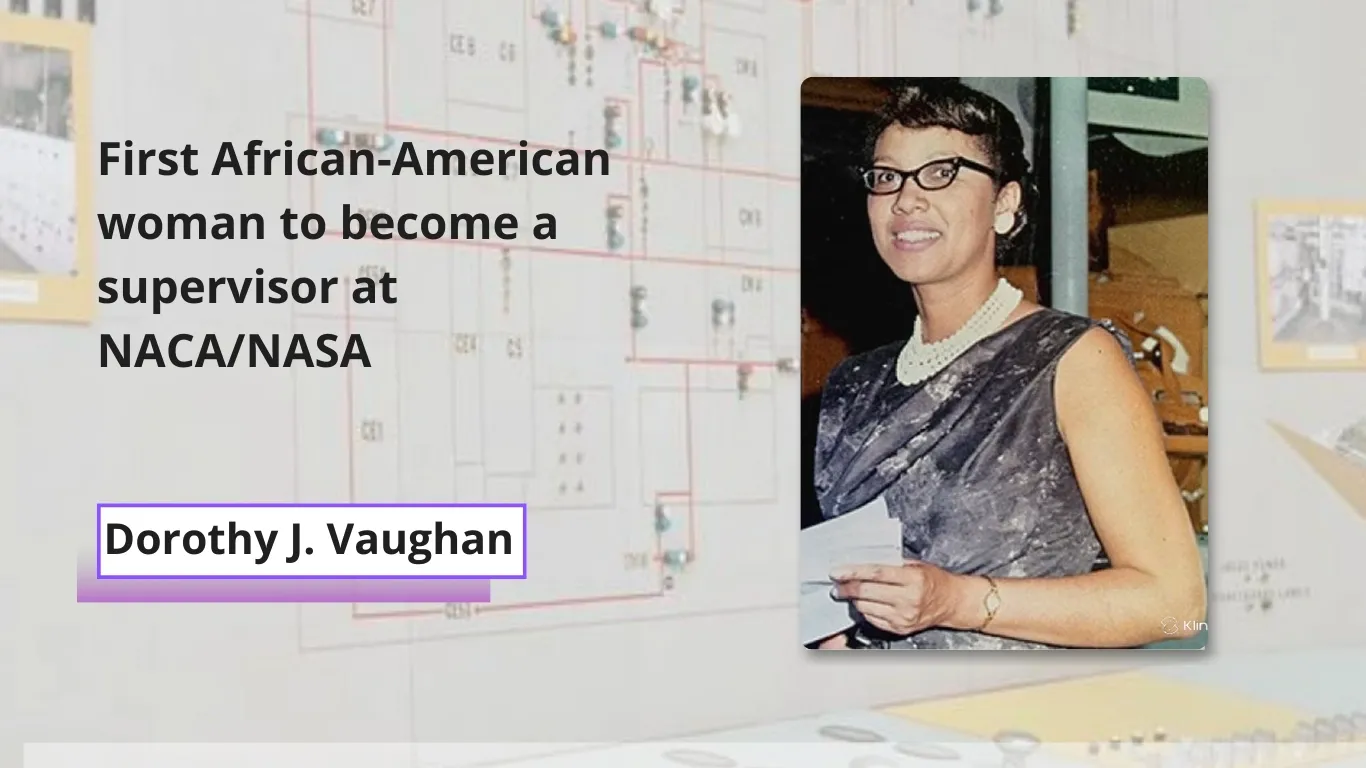
Dorothy Vaughan demonstrated an exceptional aptitude for mathematics from an early age. For an African American girl born in the United States in 1910, pursuing an education was itself a formidable challenge. Nevertheless, Dorothy showed remarkable determination, not only earning a university degree but also building a career as a mathematics teacher.
During World War II, as the nation faced an urgent demand for scientists, engineers and skilled human “computers,” Vaughan joined the National Advisory Committee for Aeronautics (NACA) at the Langley Research Center.
At Langley, the “West Area Computing” unit was established and staffed by African American women employed as human computers. Working day and night with paper and pencil, they carried out the critical calculations that underpinned the advancement of American aviation.
Vaughan began working in this unit in 1943 and quickly distinguished herself through her expertise and precision. Her excellence led to a historic milestone in 1949, when she was appointed head of the group – an extraordinary achievement for an African American woman in a technical leadership role in mid-20th century America.
The technological breakthroughs of the early 1950s, particularly the introduction of electronic computers, threatened to make the group’s work obsolete. Vaughan’s foresight, persistence and courage proved decisive. She independently learned computer programming and the FORTRAN programming language, then trained her colleagues. This effort not only ensured the group’s continued relevance but also affirmed the indispensable professional value of dozens of African American women scientists.
In 1958, NACA became NASA. Although segregation was officially abolished, true equality remained elusive. By this time, Vaughan was an accomplished programmer and contributed to major rocket programs, including the Scout program. Her calculations formed the literal foundation of space missions, even as her name remained largely unrecognized.
Vaughan retired in 1971 at the age of 61, without being offered further advancement at NASA. Many significant aspects of her life – as a pioneering scientist, a leader and a mother of six, including her work on the Mercury program during the Space Race – became widely known only eight years after her death.
In 2016, the film Hidden Figures, based on Margot Lee Shetterly’s book of the same name, brought Vaughan’s story to a global audience, alongside those of Katherine Johnson and Mary Jackson, two other African American mathematicians who worked under her leadership. The United States later honored Vaughan’s legacy with several prestigious awards, including the Congressional Gold Medal, awarded posthumously in 2019. In 2020, a rocket bearing her name was launched into space.
Additional articles in the Women in IT series are available here.